I am reading 'Adventures Among Birds' by W. H. Hudson. First published in 1913 it celebrates its centenary this year. It is remarkable and very sad how so little has changed or improved in a century!
The book contains 27 chapters, each a memoir or a musing or a series of anecdotes or idle meanderings amongst the world of birds. One such chapter is entitled 'The Sacred Bird'. You would not know by the title that he is discussing the Common Pheasant
Phasianus cochicus. The title is ironic. To most this bird is not sacred at all but to shooters, landowners, gamekeepers and their ilk it is the most sacred bird. So sacred that all other living creatures need to be extirpated to ensure the Pheasants' happy survival...so that it too can be shot! Hudson talks of the desire of landowners to make the bird artificially abundant so that an estate which yielded a dozen or twenty birds a year to the sporstman would be made to yield a thousand. This necessitated the destruction of all the wildlife supposed in any way and in any degree to be inimical to the pheasant.
 |
| Male Pheasant - Feeding in our garden |
He talks of a keeper 'Who shot all the local Nightingales because their singing kept the pheasants awake at night'. Another case is 'of an old heronry in a southern county, in the park of a great estate. On my last visit to this heronry at the breeding season I found all the nests hanging empty and desolate in the trees and was told that the head keeper had killed all the herons because their cries frightened the pheasants. They were shot on the nests after breeding had began.'
 |
| Male Pheasant - In the garden! |
And I have to quote this passage: 'Another instance...throughout a mid-June day I heard the sound of firing in the woods, beginning at about eight o'clock in the morning and lasting until dark. The shooters ranged over the whole woods. I inquired of several persons as to the meaning of all this firing, and was told that the keeper was ridding the woods of some of the vermin. More than that they refused to say; but by-and-by I found a person to tell me just what had happened. The head keeper had got twenty or thirty persons, the men with guns and a number of lads with long poles with hooks to pull nests down, and had set himself to rid the woods of birds that were not wanted. all nests found, of whatever species, were pulled down, and all doves, woodpeckers, nuthatches, blackbirds, missel- and song-thrushes shot; also chaffinches and many other small birds. The keeper said he was not going to have the place swarming with birds that were no good for anything, and were always eating the pheasants' food'.
Now I suspect things have altered very little. I was enjoying a few pints of the local bitter in a pub in North-west Norfolk last Sunday evening talking to an acquantance who lives there. I had been out walking during the day and I had seen upwards of five Ban Owls
Tyto alba and I had just finished mentioning this fact when he informed me that he had erected a Barn Owl box in his garden but was getting little joy out of it due to the local jackdaws moving in. Furthermore he was becomoing increasingly concerned about the number of Barn Owls being shot by local farmers because they were suspected of tacking pheasant chicks. I didn't know that his was happening...was it even legal? I love to see Barn Owls, I'm not too bothered about the semi-domesticated Pheasant. Then I was told that this same farmer had killed 46 Foxes last year. 46!! all caught in snares. When he was asked if this was legal the farmer replied that it was, so long as the snares are checked every 24 hours. I couldn't believe what I was hearing!
 |
Close-up of greater coverts of a dead Jay's wing
|
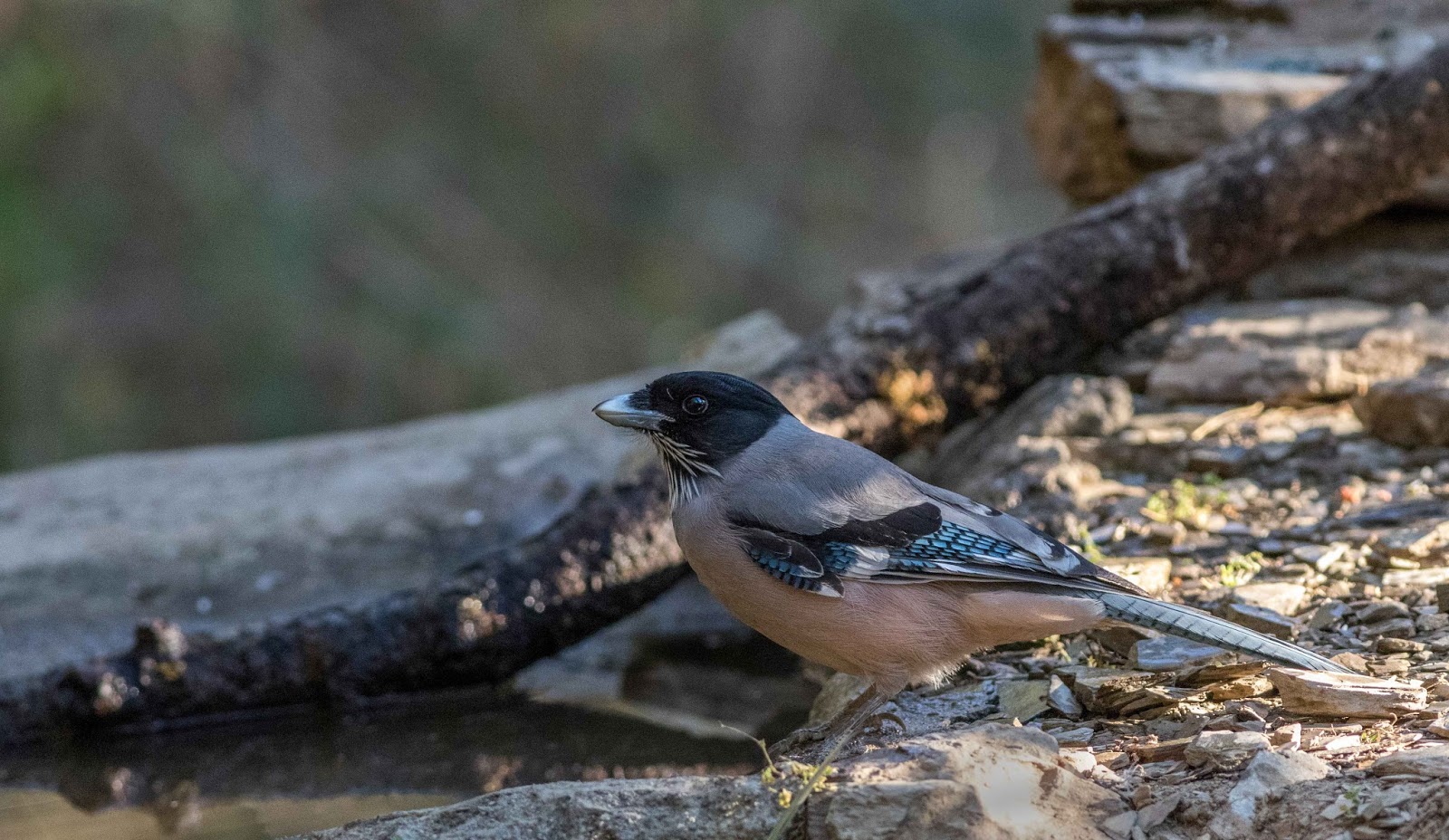
The following day we went for a walk around Holkham Park - we were there for three hours and the sound of guns going off never stopped. We only came across one shooter wandering home carring his dead pheasants. But we did find a recently deceased Jay Garrulus glandarius lying at the edge of a field. There were no obvious signs of how this bird had met its end. It clearly had not flown into anything, it had not been attacked... we suspect that it had been shot. Was it vermin? Was it a danger to the sacred pheasant chicks or was it just a laugh to shoot it!