Wednesday, December 31, 2014

Raptors in cages in photos etc Pt II

I'm continuing the post that I started yesterday with three photographs of three different Crested Caracaras. The Crested Caracara is a very popular bird with wildlife parks and is frequently to be encountered at raptor displays at county fairs and the like. Why it is so popular I can only guess. Perhaps it is easy to rear and has a good track record of breeding success. It may be able to tolerate confinement better than other species or it may respond better to human handling. Either way there is a good chance that you will encounter one of these birds if you visit a wildlife park in the UK. In the wild you would need to travel to central and southern America to see one in the wild. Up until 2002 it was thought that there was just the single species of Crested Caracara but during 2002 it was split into two. The Northern Crested Caracara Caracara cheriway and the Southern Crested Caracara Caracara plancus. I have seen both of these species: the Northern in Costa Rica and the Southern in Peru and I couldn't tell the difference. The Southern is larger but as you don't see them together you will not be able to tell! I only know they were different because of geography - their ranges do not overlap.
The three birds that I have photographed in enclosures in Britain I take to be Northern Crested Caracaras as these can be found in the south-west of the USA and I think British captive birds would originate from there The northern birds are darker too and all three of these individuals are quite dark. James Ferguson-Lees says in 'Raptors of the World' that these birds 'Walk and run easily, cruising roads for crushed corpses, joining and often dominating vultures at carcases where they may pick out the maggots.' A really nice image... I can see why they are favourites of bird-keepers!


No 2 Northern Crested Caracara Caracara cheriway

Presumed Northern Crested Caracara Caracara cheriway Woodland Wildlife Park, Lincs October 2014

Northern Crested Caracara Caracara cheriway  IBPC Yorks, Sept 2014
 Note that the face is yellow on this individual and not red as in the other two. The face colour can range from pale yellow to a deep orange-red.
Northern Crested Craacara Caracara cheriway. Thorsby Hall County Fair, Notts, March 2013

Raptors in cages in photos.

Over the past few months I have visited a few wildlife centres such as the International Bird of Prey Centre at Helmsley in Yorkshire, a Wildlife Park in Lincolnshire and a local butterfly farm. My intention has been to photograph all of the species of birds that are held in captivity, especially diurnal and nocturnal birds-of-prey. I want to present them as sort of 'old school works of art'...birds out of their natural habitat as often painted by nineteenth century artists. Enclosed and entrapped they all seem to blend into the very fabric of their cages. By using textures to enhance the backgrounds of the photographs I have tried to show the birds melding into their surroundings...becoming a part of their enclosures if you will. This appearance of blending is enhanced due to the photographic requirements. The birds are nearly always behind thick metal mesh wire and this gives a cross-hatched pattern over the birds. To avoid this I find that the bird needs to be as far beyond the mesh as possible...at the back of the pen in other words. They always look a bit forlorn when they are so sited. Although I could be accused of being anthropomorphic they seem to my eye to be skulking, nervous or, at best, resigned. I expect that they are probably not as most get flown on a regular basis, are properly fed and cleaned and are moved to more suitable quarters when the weather gets bad.
As well as the birds needing to be as far from the enclosure wire as is possible I have to get as close to the cages as I can to ensure blurring of the mesh as well as focus on the bird. Long focal length lenses are not much use therefore and neither are wide angle lenses. The optimum focal length for me is 200mm.
The other issue is light. Or rather the absence of light. When the bird is at the back of the pen this area is more often than not covered and so too are the sides. It is like shooting pictures in a box! High ISO settings are often needed and this adds unwanted noise to the images, or a long exposure is required. Fortunately for me the birds are quite often very still for quite long periods of time. I don't know what this indicates about their state of mind!
I will be posting low resolution versions of some of the images on this site and higher res. images will be available to view on my website www.andymasonphotography.com

No 1. Bateleur Terathopius ecaudatus.


The Bateleur is one of my favourite birds because it was card No 1 in the Brooke Bond Picture Card album 'Tropical Birds' back in the 1960's. A fantastic painting by Tunnicliffe of a 'handsome, short-tailed, crested eagle...often it may be observed soaring in circles, watching whatever is afoot below it, and sometimes uttering a deep, jackal-like call.' Tremendous stuff. This was the bird to see. Short-tailed is a bit of an understatement as in flight it appears to have no tail at all...hence its spot on specific name of ecaudatus meaning no-tail!
A couple of years back I spent two weeks in the Gambia being the only person not to see one of these even though they can be fairly reliable. This bird was photographed at the IBPC in Yorkshire back in September.

Wednesday, December 10, 2014

Winter Flocks


Driving around the vale of Belvoir this lunchtime looking for bits of tweed I was struck by the numbers of birds beginning to form winter flocks. Rooks and Jackdaws were the most conspicuous with some Rooks apparently gathering twigs to repair and strengthen nests! Fieldfare numbers were high as were Redwings but as is usual with both of these thrushes they were very wary and I could not get close enough to get decent pictures. Blackbird numbers were quite high and one flock of a dozen birds were probably of the continental birds: long-winged and black-billed; very different to the usual Blackbirds.
Kestels were not forming flocks...but there were a couple of females working the roadside verges and unlike the thrushes they were so busy looking for food that my presence did not bother them too much and so I managed to get a few decent images of one of the birds.
We went to look for Common Buzzards on the road leading into Bingham and sure enough we found three sitting in a field and the nearest bird was carrying a large wing-tag which I think was numbered 11. All three birds skiddadled to the far side of the field and as I had no binoculars I couldn't really see the tag so I will go back tomorrow and see if I can get good images of at least one of the birds. I wasn't aware that there was any wing-tagging of Common Buzzards in this area.


Redwing Turdus iliacus feeding on Haws

Redwing Turdus iliacus feeding on Haws

Female Kestrel Falco tinnunculus hunting

Female Kestrel Falco tinnunculus hunting
 

Female Kestrel Falco tinnunculus hunting
 

Female Kestrel Falco tinnunculus hunting


Female Kestrel Falco tinnunculus hunting
 

Female Kestrel Falco tinnunculus hunting


Thursday, November 27, 2014

Seals at Donna Nook


The grey seal (Halichoerus grypus, meaning "hooked-nosed sea pig"- which is not very complimentary) was the target of a photography trip to the Lincolnshire Wildlife Reserve at Donna Nook this morning. The weather was pretty awful and in consequence the photographs were pretty ordinary to say the least. I had to rack up the ISO to 1600 and the resulting noise on the photographs was lousy. Still there were plenty of seals loafing about doing what seals do - which is not much.
According to the Lincolnshire Wildlife website there are slightly over 3 000 seals hauled up on the mud and salt marsh of this part of the Lincolnshire coast this week. 2 500 of these are cows and their pups, the remaing 500 or so are bulls which tend to be quite aggresive at this time. I was more surprised by the numbers of visitors. Bear in mind that it was a miserable, damp and dank Thursday morning in November yet the car park was packed to overflowing and the viewing area was busy along its entire length. There were a couple of school parties present..."What we gonna do ere for six hours." I overheard as we passed a group of enthusiastic students. What indeed.
Birds were fairly scarce. Flocks of Shelduck and Brent Geese were visible towards the shore-miles away! A few Little Egrets further down the coast at Howdon's Pullover, Redshank, Turnstone and over 30 Curlew and a few Lapwing and Skylarks flying over. The best count was of a flock of Yellow Hammers in excess of 150. A pair of Stonechats were on the grass bank but that was about it. It got even greyer, murkier and damper so we cleared off before the rain set in. Pity those school kids...they still had four hours left.
Snoozin Grey Seal Halichoerus grypus

Piece of old rope - a long-lived bull

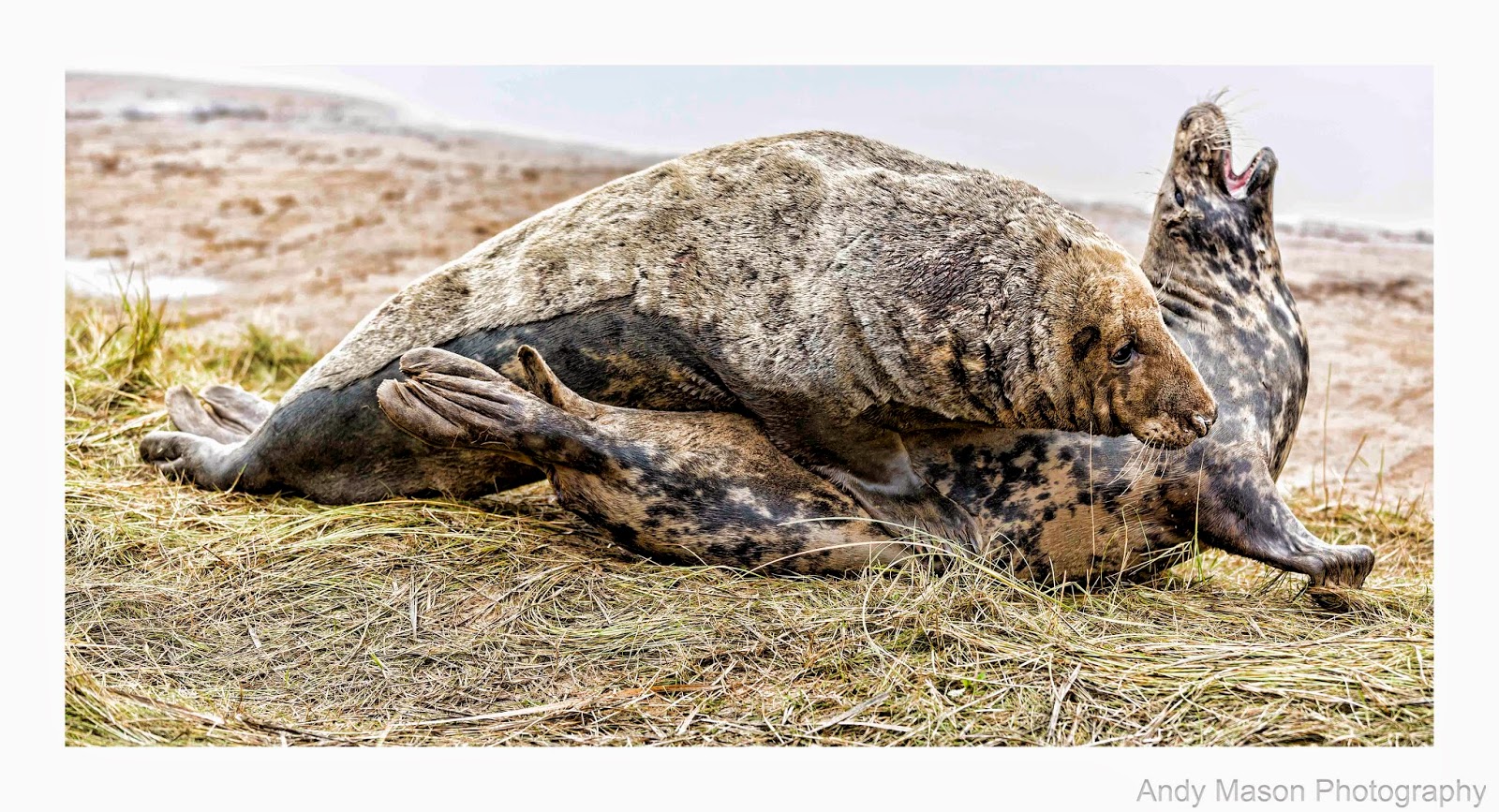
An amorous old bull and a not too happy female!

The female seemed to be a bit happier!

All rather boring to this pup.

More snoozin'

Scratchin'

Lollin' about in the mud.

Male Stonechat Saxicola torquatus

Male Stonechat Saxicola torquatus

Monday, November 24, 2014

Starlings and Sunsets

I'd almost forgotten I had this blog..it's been so long since I added a new post. This afternoon/early evening we visited Netherfield Lagoons in Notts, on the advice of some friends, to witness a small but nonetheless impressive Starling roost. There is always a chance of a 'murmuration' so I took along my camera. The light was tremendous and although there were only about 4 000 Starlings they performed well. Canada Geese flying in to roost added to the atmosphere as well as the general noise level. A single Barnacle Goose was noted flying with some of the Canada Geese. A Water Rail put in a brief appearance and a Bittern flew over the lagoon in the twilight. Magical!

Canada Geese and a Crescent Moon.

Starlings diving into the reeds behind this tree.

Yer murmuration!

More murmurings.

Tight flock
 

Wednesday, October 1, 2014

Peregrine Pictures

This Peregrine was performing in Lincolnshire this morning. As fast as it was the Canon camera and lens was up to the task! I've taken a bit of a liberty with a texture in Photoshop with the last image as I wanted to punch up the sky to make it a bit more arty!
Peregrine Falo peregrinus, Lincs


Peregrine Falo peregrinus, Lincs

Peregrine Falo peregrinus, Lincs

Peregrine Falo peregrinus, Lincs. With tastefully applied texture to the sky!

Wednesday, September 17, 2014

Red in Tooth and Claw


I managed to get a few shots of a Sparrowhawk taking a Collared Dove as a prey item earlier today. Taken through the kitchen window on my wife's compact camera which was handily next to the sink! This is the third Collared Dove to be taken in as many days, we suspect, as there were feathers of one gone bird in the garden yesterday and a moribund bird in the garden earlier on this morning before this bird made the ultimate mistake by wandering about on the lawn.
This is a juvenile bird and can be identified by the dark brown upperparts, rufous edges to the forewing (which is just visible in the last three pictures) and the barring on the underparts which is quite strong and could indicate a male. The Spar was busily plucking away before being spooked by a Magpie which was clearly uncomfortable about the presence of the hawk.

Juvenile Sparrowhawk Accipiter nisus killing a Collared Dove Streptopelia decaocto

Juvenile Sparrowhawk Accipiter nisus killing a Collared Dove Streptopelia decaocto

Juvenile Sparrowhawk Accipiter nisus killing a Collared Dove Streptopelia decaocto

Juvenile Sparrowhawk Accipiter nisus killing a Collared Dove Streptopelia decaocto
 The Sparrowhawk landed with its kill in another part of the garden after moving away from the Magpie but it was not to enjoy its meal as a neighbour's bloody chicken went to investigate and the Sparrowhawk thought it prudent to clear off leaving most of the dove un-eaten. There are now good sized bits of three Collared Doves scattered about the garden!
Juvenile Sparrowhawk Accipiter nisus killing a Collared Dove Streptopelia decaocto

Juvenile Sparrowhawk Accipiter nisus killing a Collared Dove Streptopelia decaocto