After Michaela’s beaver action and the wonderful ‘How to
identify a Pole Cat.’…’Er…that’s a Pine Martin, mate.’ episode on Tuesday
night, Wednesday night’s episode of Autumnwatch was a must see programme. After
the rib-tickling comment that when a ‘Scottish Wild Cat finds domestic pussy that would be very attractive, thank you very much’
we moved on to some insightful stuff on the migration routes of European
Swifts.
By attaching those tiny 1.3gm geolocators to the backs of
Swifts new information has come to light. The BTO has tagged and recaptured
nine Swifts and they show that Swifts in their wintering areas on the African
continent move great distances to exploit temporarily superabundant food
sources. Most interesting appears to be the stopover in Liberia where returning
spring migrants spend ten or so days refuelling on aerial termites before
heading north over the Sahara desert. However what amazed me the most was the
journey undertaken by Swift A320 out over the Atlantic Ocean. Looking at the
map of its travels it left the west coast of Congo Central on 14th
April 2011 and arrived over Liberia on 17th April - two or three days at sea.

Chris Mead says on page 61 of ‘Bird Migration’ published in
1983: ‘Swifts are supremely aerial and
yet shun long sea crossings on migration.’
At the time Chris Mead knew his onions. He had worked for the BTO since
the 1960s primarily in the ringing section and at the time of the publication
of ‘Bird Migration’ he had handled over a quarter of a million wild birds
during ringing operations. Chris wasn’t to know that Swifts do not shun sea
crossings…new technology and the continuing work of the BTO and its volunteer ringers
has discovered this. (Click on this link to access a detailed map of Swift A320
and find out more about its amazing journey.) http://www.bto.org/sites/default/files/u49/BTO_299_16-17Swifts.pdf

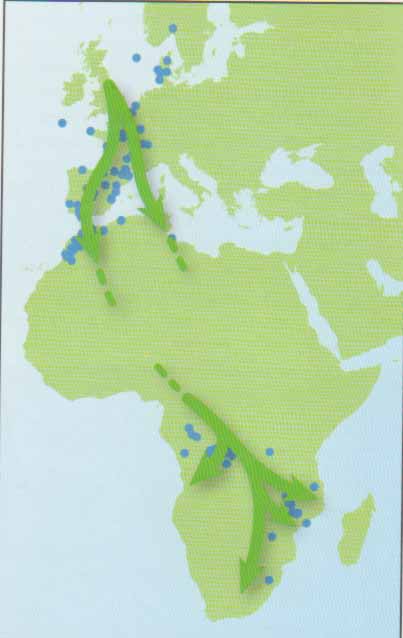
By 2004 and the publication of the BTOs ‘Time To Fly.
Exploring Bird Migration.’ There were still gaps in our knowledge. The
migration map shows birds crossing the Mediterranean Sea into North Africa
before disappearing and then reappearing in Central and Southern Africa.
Clearly there was no idea that the birds followed the countries of the Western
seaboard of Africa.
For
a really detailed and analytical account of Swift migration you should check
pages 443 – 445 of the BTOs mammoth publication ‘The Migration Atlas’
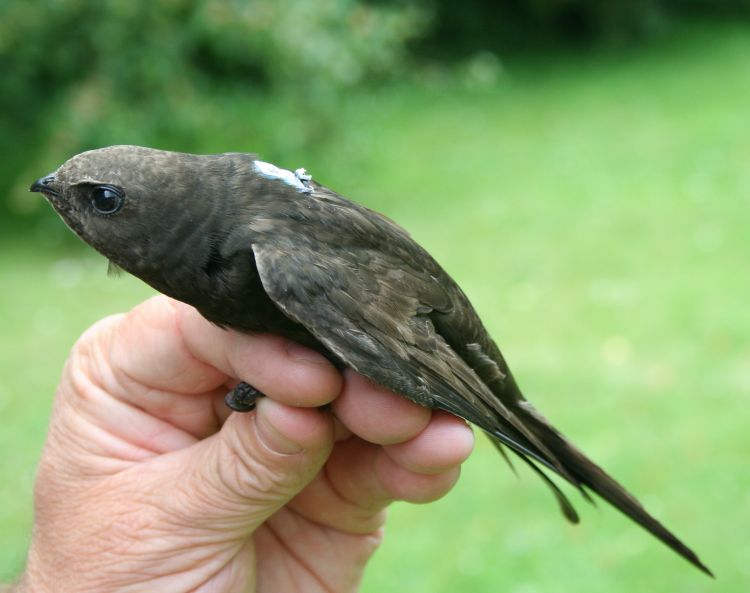
In the mid 1980s I spent many a summer’s evening ‘Swift-Flicking’
in west Notts and what I remember most were the huge parasitic flies that lived
out their lives between the feathers of the Swift’s wings. I don’t remember any
of our ringed Swifts being recovered. But recoveries of other groups’ ringed
Swifts were made. In 1976 a bird ringed in Warwickshire twelve years earlier was
recovered in Mozambique after it had been shot!
Without the continuing work of the BTO and its volunteers we
would be so much poorer in our knowledge of and understanding of so much about
our birds. It makes you wonder what we will find out over the next ten or
twenty years. Meanwhile it's episode three of Autumnwatch tonight!


